

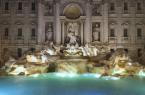
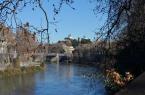














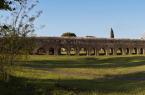















In Monti di Pietralata, close to the Aniene and in correspondence with the Marranella ditch, runs one of the few sections of the Acquedotto Vergine built above ground. The powerful infrastructure is still functional and transports water to the Trevi Fountain.
This section of the conduit is 320 m long, the height of the structure varies between 8 and 13 m. What appears to be a difference in level actually represents the strategy to keep the water flowing at the same level and accommodate the differences in level of the terrain. The original infrastructure must have been built with masonry in opus cementitious covered with rhomboidal section tuffs. Numerous ancient and modern maintenance interventions have made the structure a continuous solid wall that crosses the Marranella ditch with an arch more than 4 m wide.
Proceeding towards via Nomentana the height of the monument decreases abruptly because starting from the intersection with via di vigna Mangani the conduit resumes its underground course.
The entire structure is strengthened by a double series of buttresses covered in bricks.
The most recent restoration, from the twentieth century, focuses on the conduit in which the water flows, raising the entire infrastructure.
The northern front, along Via di Pietralata, is covered in bricks attributable to the numerous restoration works that have taken place over time, the first of which was carried out by Benedict XIV in the 18th century. On this same front there is a small structure used as a hydrometer, as indicated on the plaque on its entrance door, dating back to 1867: SPQR ACQUA VERGINE IDROMETRO ANNO MDCCCLXVII. Behind the hydrometer, a few metres further east, there is a discharge structure and the relative control chamber built to control the speed of the water and the flow rate of the conduit in which the water flows at free surface.
Near the ditch, in the infill structure of one of the original arches of the viaduct, a passage has been created which is accessed from the street level via a staircase. On the marble architrave there is an inscription from 1861: SPQR ANNO MDCCCLXI.
The lower part of the S face, inside the Parco dell'Aqua Virgo, is still partially covered, excluding the twentieth-century restoration, by a layer of protective plaster. In the areas where this is not preserved and in the gaps in the brick curtain, the underlying original structures can be glimpsed. Therefore, on this side it is possible to observe parts of the original structure in reticulated tuff work on arches closed over time to consolidate and reinforce the infrastructure, which runs on uneven terrain. The closing of the arches and the reinforcement of the lower part of the viaduct, made of bricks of more modest workmanship, can probably be attributed to a restoration that took place in the late imperial age.
The brick arches and the mixed-material curtain walls belong to later restorations.
Information
Ingresso libero
 Condividi
Location
To find out about all accessibility services, visit the Rome accessible section.