





















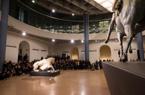








The ethnographic collections of the “Luigi Pigorini” National Prehistoric Ethnographic Museum include over sixty thousand objects produced by non-European native cultures. Some pieces, such as arms, masks, ivory objects coming from Congo, Angola, Sierra Leone, Mexico, the Antilles, and Canada were already part of the seventeenth century Kircherian Museum. The collections that Italian travelers and explorers brought back from the African Continent between the end of the nineteenth and the beginning of the twentieth century, such as fetishes, arms, ornaments, and nineteenth century costumes of Abyssinia were successively added to this first core. Instead the testimonies of the Amazonian, pre-Colombian, Eskimo, and Indian cultures come from America. Valuable objects and wooden sculptures come also from Oceania (New Guinea, NewCaledonia, and the Salomon Islands). The large ceremonial canoe coming from the Island of Kitawa (Trobriand Islands) is perfectly preserved. The sector dedicated to Prehistory and Protohistory embraces a span of time that goes from the Neolithic (six thousand years BC) to the Iron Age (from the ninth to the seventh century BC). The testimonies of the Iron Age are Etruscan, Umbrian, Picene, and Nuragic findings. The golden “fibula prenestina” is of particular interest, because it holds one of the most ancient inscriptions in the Latin language. An ad hoc didactic route also documents the extraordinary evolutionary course of our species and the current issues associated with the excavation, retrieval, and analysis of findings.
Informations
For the opening times and guidelines please check the official website
https://museocivilta.beniculturali.it/prepara-la-visita/.
 Condividi
Location
Pour connaître tous les services d'accessibilité, visitez la section Rome accessible.